
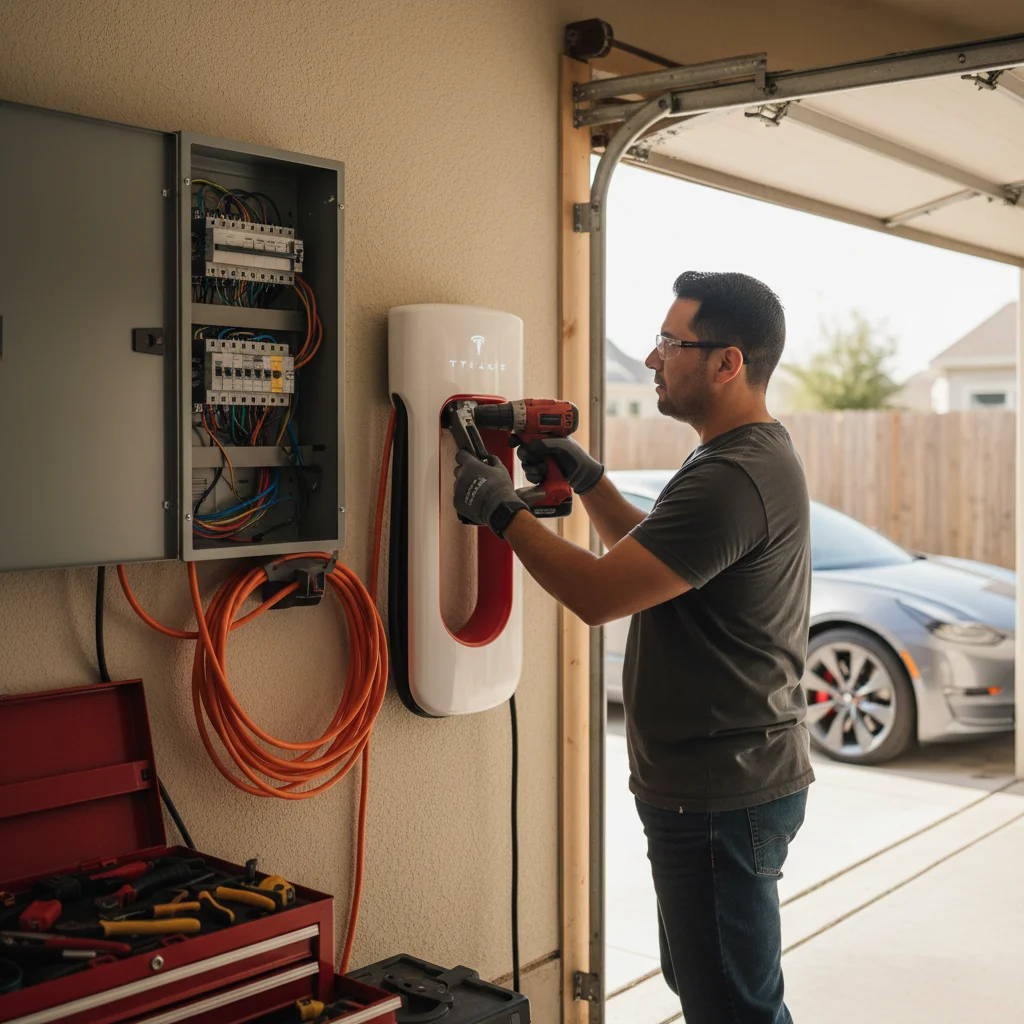

EV Charger Installation in North Texas — Tesla Certified, Panel-Ready, Code-Compliant
EV charger installation in North Texas starts with a panel capacity assessment — not just mounting hardware on a garage wall. Beachy Electric is a Tesla Certified Installer serving Collin, Denton, and Dallas counties with full load calculations, dedicated 240V circuits, and permit handling for every city in the service area. Call 469-283-1089 for your free assessment.
EV Charger Installation at a Glance
- Tesla Certified: Wall Connector + Powerwall installer — warranty-compliant
- Also Installs: ChargePoint Home Flex, Emporia, Grizzl-E, JuiceBox, ClipperCreek
- Charging Type: Level 2 (240V) — 25–30 miles of range per hour of charge
- Panel Check: Full load calculation included — panel upgrade quoted if needed
- Permit: Pulled and inspected per city requirements in Collin, Denton, and Dallas counties
- Cost Range: $800–$2,200 depending on panel capacity and circuit run length
- Solar Integration: Enphase + SolarEdge certified for combined EV + solar systems
Why Level 2 Charging Is Non-Negotiable in North Texas
EV adoption across the DFW metroplex has accelerated faster than the charging infrastructure can keep up. Tesla Model Y and Model 3 dominate new registrations in Collin County, but Ford F-150 Lightning, Hyundai Ioniq 5, and Rivian R1S are showing up in driveways from Frisco to Flower Mound. Every one of these vehicles ships with a Level 1 charger — a standard 120V plug that recovers roughly 3–5 miles of range per hour. For a Model Y with a 75 kWh battery, that means 40–60 hours to reach a full charge from empty. That timeline doesn’t work for a homeowner in McKinney who commutes 35 miles each way down US-75 to downtown Dallas.
Level 2 charging operates on a 240V circuit — the same voltage your dryer uses — and delivers 25–30 miles of range per hour. A typical overnight charge of 8 hours recovers 200+ miles, covering most North Texas commutes with margin to spare. The catch: most homes built before 2010 in Garland, Richardson, and south Plano were constructed with 100-amp or 125-amp main panels. Adding a 40–50 amp dedicated EV circuit to a panel already running HVAC, water heater, range, and dryer often pushes the total load past the panel’s rated capacity. That panel needs upgrading to 200 amps before the charger goes in — and skipping the load calculation is how breakers trip at 2 AM.
Newer construction in Celina, Prosper, and Anna typically ships with 200-amp panels, but that doesn’t mean a free 50 amps are sitting unused. Between dual-zone HVAC systems, tankless water heaters, and smart home setups, those panels fill up faster than builders anticipate. A load calculation tells you the truth before you commit to a charger model. And with ERCOT grid pricing in Texas, charging overnight during off-peak hours (typically 9 PM to 6 AM) can cut your per-mile electricity cost to under 3 cents — a fraction of what the same commute costs in gasoline.
Geography plays a role too. A homeowner in Wylie commuting 25 minutes to Richardson along SH-78 racks up 45 miles round-trip daily. Murphy and Sachse residents heading south on US-75 toward downtown Dallas face similar mileage. Public Level 2 stations exist along the DNT corridor and at Stonebriar Centre in Frisco, but relying on public chargers means waiting 30–45 minutes for a partial charge and paying $0.30–$0.45 per kWh — four to five times the cost of charging at home overnight. Installing a dedicated Level 2 charger eliminates the detour, the wait, and the premium pricing. Call 469-283-1089 and we’ll verify your panel before anything gets mounted.
What You Get with Beachy Electric EV Charger Installation
Panel Capacity Verification — Before You Buy the Charger
Every EV charger installation starts with a full NEC load calculation on your existing panel. We meter actual draw across all circuits, not just breaker ratings, because a 200-amp panel in a The Colony home with two HVAC units and a pool pump may have less available capacity than a 150-amp panel in a smaller Fairview ranch. If a panel upgrade is needed, we quote it upfront — no surprises on installation day.
Tesla Certified Installation — Warranty-Compliant
Beachy Electric holds Tesla Certified Installer status for Wall Connector and Powerwall installations. That certification matters because a non-certified installation can void the Tesla warranty on the charger hardware. We follow Tesla’s exact wiring specifications, mounting requirements, and commissioning procedures. Homeowners in Plano and Allen with Wall Connectors get the full Tesla app integration and load-sharing configuration verified on-site.
Permit + Inspection Handling — Every City, Every Time
McKinney‘s building department processes EV charger permits differently than Frisco‘s. Little Elm requires a site plan with the permit application. Denton has its own inspection scheduling system. We handle permit filing, coordinate inspections, and provide the documentation your city requires. You don’t call the building department — we do.
Solar + Battery Integration — Enphase and SolarEdge Certified
If your home already has rooftop solar or you’re planning an installation, your EV charger can draw from solar production during peak sun hours and switch to grid power overnight at off-peak ERCOT rates. Beachy Electric holds Enphase and SolarEdge certifications, meaning we configure the inverter-to-charger communication, battery backup priority settings, and load management so your Prosper or Flower Mound home charges intelligently — not just whenever the plug is connected.
EV Charger Installation Services and Costs
| Charger / Service | What’s Included | Typical Cost |
|---|---|---|
| Tesla Wall Connector (Hardwired) | 48-amp hardwired install, dedicated circuit, load calc, permit, Tesla commissioning | $1,200–$1,800 |
| ChargePoint Home Flex | Up to 50-amp circuit, Wi-Fi configuration, permit, load calc | $1,000–$1,600 |
| NEMA 14-50 Outlet Only | Dedicated 240V/50A outlet in garage, circuit from panel, permit | $800–$1,200 |
| Panel Upgrade + EV Circuit | 100A to 200A panel swap, new EV dedicated circuit, city inspection | $2,800–$4,500 |
| Tesla Powerwall Battery Backup | Powerwall install, gateway, solar tie-in, whole-home backup config | $12,000–$16,000 |
| Solar + EV Integration | Enphase/SolarEdge inverter config, charger scheduling, load management | $1,500–$2,200 (add-on) |
All pricing includes permit fees and city inspection. Circuit run length affects cost — a panel on the opposite end of the house from the garage adds $200–$400 in conduit and wire. Call 469-283-1089 for a written estimate specific to your home.
How EV Charger Installation Works
Initial Call — Vehicle + Charger Discussion
Call 469-283-1089 or submit online. We ask about your vehicle (Tesla, Ford, Rivian, etc.), your preferred charger model, garage location, and whether you’ve noticed any existing electrical issues. Homeowners in Plano and Richardson typically get same-day or next-day appointments.
Panel Capacity Assessment
On-site, we open your main panel, meter actual draw across every circuit, and run a full NEC Article 220 load calculation. In older Garland and south Plano homes with 100-amp panels, we calculate exactly how much headroom exists and whether a panel upgrade is required. No guessing, no assumptions.
Written Estimate with Options
You receive an itemized quote covering labor, materials, permit fees, and inspection costs. If your panel needs upgrading, we quote both the upgrade and the charger install as separate line items so you see exactly where every dollar goes. We also present charger options — Tesla Wall Connector vs. NEMA 14-50 outlet — with pros and cons for your specific driving pattern.
Permit Filing + Materials Procurement
We file the electrical permit with your city’s building department — Frisco, McKinney, Allen, Denton, or whichever municipality covers your address. Wire gauge, conduit type, breaker amperage, and mounting hardware are sourced and staged before installation day.
Installation + Circuit Testing
The dedicated circuit runs from your panel to the garage. Hardwired chargers (Tesla Wall Connector, ChargePoint) get direct wiring; outlet-based setups get a NEMA 14-50 receptacle rated for continuous 40-amp draw. Every connection is torqued to NEC specification, and we verify voltage, amperage, and ground fault protection before mounting the charger.
Charger Activation + Walkthrough
We power up the charger, connect it to your vehicle, verify charging rate, and walk you through the app configuration (Tesla, ChargePoint, or manufacturer-specific). For Tesla Wall Connectors, we complete the commissioning checklist that validates the warranty. City inspection is scheduled — we attend it so you don’t have to.
Frequently Asked Questions — EV Charger Installation
A NEMA 14-50 outlet installation runs $800–$1,200 in most North Texas homes. A hardwired Tesla Wall Connector or ChargePoint Home Flex costs $1,200–$1,800 including the dedicated circuit, permit, and inspection. If your panel requires an upgrade from 100A to 200A, add $1,800–$3,000. Circuit run length is the biggest variable — a panel in the utility room 40 feet from the garage costs more than one mounted on the garage wall. Call 469-283-1089 for an exact quote.
It depends on your current panel capacity and existing load. Homes in Garland and Richardson built in the 1970s–1980s typically have 100-amp panels with limited headroom. A Level 2 EV charger draws 40–50 amps continuously. Beachy Electric runs a full load calculation during the assessment — if your existing draw plus the charger exceeds 80% of panel capacity, a panel upgrade is required by NEC code. Newer homes in Celina and Prosper with 200-amp panels usually have enough room.
A NEMA 14-50 outlet is a standard 240V receptacle that works with any portable charger — Tesla Mobile Connector, ChargePoint, or third-party. It caps at 32 amps when using Tesla’s adapter. A hardwired Tesla Wall Connector delivers up to 48 amps and supports power sharing between two units if you have multiple EVs. If you only drive a Tesla and want maximum charging speed, the Wall Connector is the better investment. If you want flexibility for future vehicles from different manufacturers, the NEMA 14-50 keeps your options open. Call 469-283-1089 to discuss your setup.
A straightforward installation — panel on the garage wall, no upgrade needed — takes 3–4 hours. If the circuit runs through the attic or crawl space from a panel inside the house, allow 4–6 hours. A panel upgrade from 100A to 200A adds a full day (the utility company must disconnect and reconnect the meter). From first call to charging, most Plano and Frisco installations complete within one week including permit processing.
Yes. Any new circuit installation in Texas requires an electrical permit and inspection. Each city in our service area — McKinney, Allen, Little Elm, Denton, Dallas — has its own building department and permit process. Beachy Electric handles the entire filing and coordinates the inspection. An electrician who skips the permit is cutting a corner that affects your home insurance coverage and resale value.
Possibly, but only a load calculation can confirm it. A 100-amp panel with central AC (30–40 amps), electric range (40 amps), dryer (30 amps), and water heater (20 amps) is already near its limit before adding a 40-amp EV circuit. NEC code requires that total calculated load stay under 80% of panel rating. Many 1970s–1990s homes in Garland, south Plano, and Carrollton need a 200-amp upgrade before the EV charger is safe to install. Call 469-283-1089 — the assessment is free.
Yes, and North Texas gets 230+ sunny days per year, making solar + EV a strong combination. Beachy Electric is both Enphase and SolarEdge certified, so we configure the inverter and charger to communicate. During peak sun hours, your EV charges from solar production. Overnight, it switches to grid power during ERCOT off-peak rates. Add a Tesla Powerwall for battery backup and your Flower Mound or Prosper home can ride through grid outages while keeping the car charged.
Level 1 uses a standard 120V household outlet and adds 3–5 miles of range per hour — roughly 40–60 hours to fully charge a Tesla Model Y. Level 2 uses a 240V circuit (same voltage as your dryer) and delivers 25–30 miles per hour, completing a full charge overnight in 8–10 hours. Every EV ships with a Level 1 charger, but for daily commuters in McKinney, Allen, or Wylie driving 30+ miles each way, Level 2 is the practical minimum. A licensed electrician installs the 240V circuit and charger properly.
EV Charger Installation Service Areas
Denton County HubDentonLewisvilleFlower MoundLittle ElmThe ColonyCorinthHighland VillageAubreySanger
Don’t see your city? Call 469-283-1089 to confirm coverage.
Ready to Charge at Home?
Tesla Certified. Panel-verified. Permitted and inspected. From a Master Electrician with 17+ years in North Texas.
Free Assessment • Same-Day Scheduling • Written Estimate